Self-discovery · the recovery, not the search

You don't find yourself. You recover yourself.

The person you're looking for isn't hiding in a new city, a new job, or a better morning routine. They're underneath the conditioning, and there's a faster way in than staring harder at the mirror.

Part of the self-discovery series · prefer questions to essays? Start with questions to ask yourself.

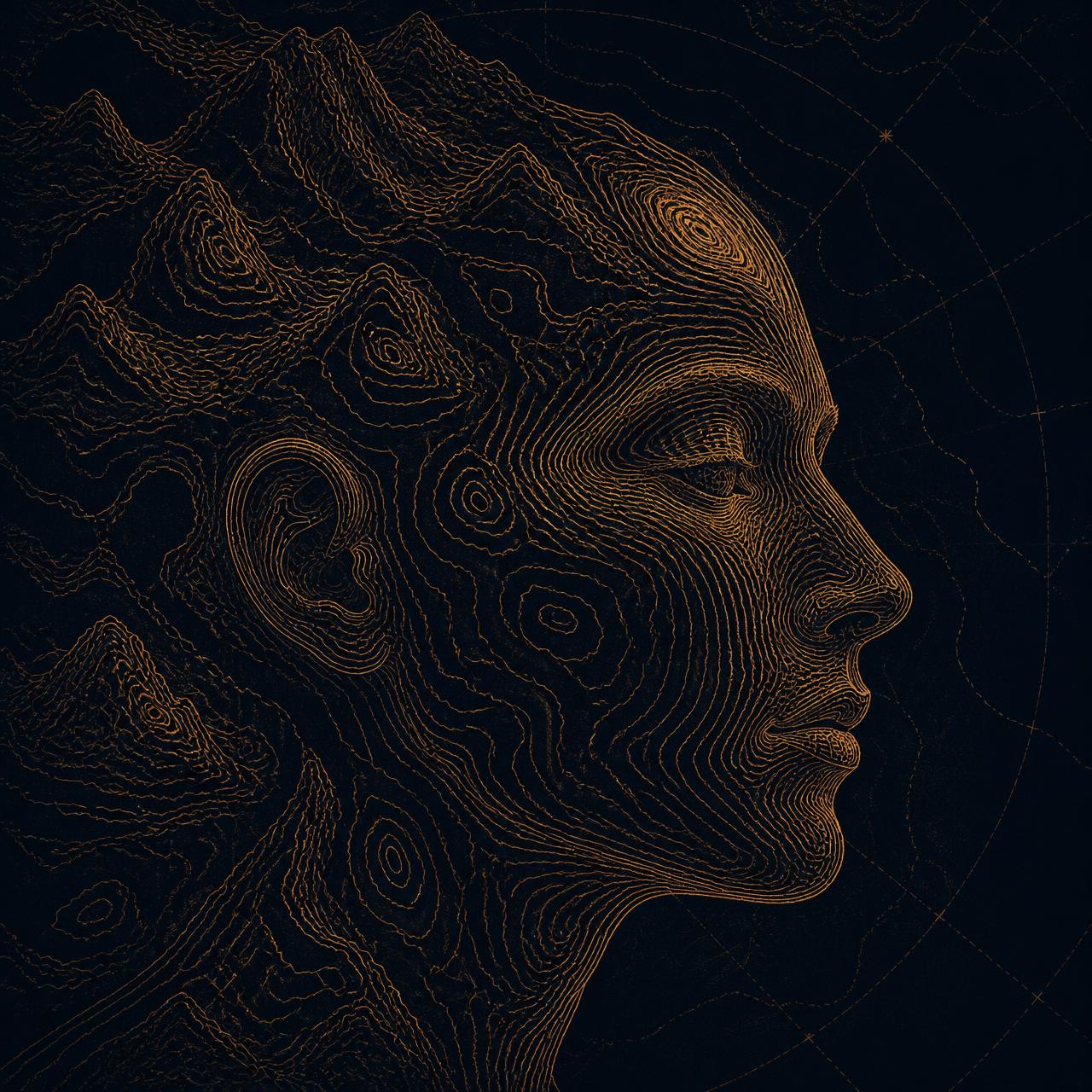
A human face in profile drawn entirely as glowing topographic terrain lines

Fig. I · The terrain of you

§ I · Why trying harder fails

The mirror problem.

The standard advice for finding yourself is to look inward: journal more, meditate more, ask deeper questions. Sometimes it works. Often it loops, because introspection examines you with the very instrument that got confused in the first place. Your current self-image asks the questions, filters the answers, and declares the results. That's not a search. That's a hall of mirrors.

What breaks the loop is an outside reference: something specific about you that you did not write yourself, that you can hold your actual life against and say "true" or "false." For some people that's therapy. For some it's honest friends. And for a growing number it's their birth chart, read not as fortune-telling but as a structured set of claims about how they decide, where their energy goes, and what they keep absorbing from other people. The claims are checkable. The checking is the finding.
§ II · The sequence

Five moves, in order.

IStart from what cannot shift

Every serious search needs one fixed point. Yours is the sky at the minute you were born: it produces your energy type, your decision mechanics, your core pattern. You can argue with any of it, and you should. But it gives the search coordinates, which is exactly what staring at a blank journal page never does.

IIConfirm, don't believe

A chart is a hypothesis about you, not a verdict. Take each claim it makes and test it against your actual history: the jobs that drained you, the decisions you regret, the way you argue. Keep what your life confirms. Discard the rest without ceremony. Self-knowledge you did not verify is just someone else's opinion wearing your name.

IIISeparate yourself from your conditioning

Much of what you call "me" is absorbed: the ambition that is actually your father's, the urgency that belongs to your workplace, the emotional weather you picked up in a room and carried home. The open centers in your design mark exactly where you absorb and amplify other people. Knowing where the borrowing happens is most of the finding.

IVWatch decisions, not moods

You are not what you feel on a Tuesday. You are how you decide, over years. Track one thing for a month: which choices came from your actual decision mechanism, and which came from pressure, and what each kind cost you. The pattern that emerges is more "you" than any personality test result.

VLet something remember with you

Finding yourself fails as a weekend project because insight evaporates. The realization you had in March is gone by May unless something holds it. A journal works if you sustain it. A companion that remembers every conversation and connects this month's pattern to last month's works better, because the connecting is the hard part.

§ III · Eva

The search, with a witness.

Eva runs this sequence with you. She calculates your complete chart from your birth minute, then shows you its claims one at a time and asks the only question that matters: is this actually you? What you confirm becomes her working model. What you deny gets discarded. And because she remembers every conversation, the pattern you half-noticed in March is still on the table in May, connected to the new evidence.

The chart is free, takes ninety seconds, and gives the search what it's been missing: a starting point that isn't a blank page.

§ IV · Questions

Asked, in the quiet.

Why can't I find myself no matter how much I reflect?

+

Because reflection uses the instrument that produced the confusion: your current self-image asks the questions and filters the answers. It loops without an outside reference point. Give it fixed claims to test against your real history and the loop breaks.

How long does this take?

+

The chart takes ninety seconds and either resonates or doesn't. Verifying it against your real decisions is a practice of months. The honest reframe: it isn't a destination, it's resolution that keeps increasing.

Is "finding yourself" different from "getting to know yourself"?

+

Same work, different moment. Finding is what you call it in a crisis, usually after a role ended. Knowing is the ongoing version, done from curiosity. This sequence serves both.

Do I need to believe in astrology or Human Design for this to work?

+

No. You need to be willing to test specific claims against your actual life. Treat the chart as a hypothesis generator, keep what your history confirms, and discard the rest. Skeptics often get more out of this than believers, because they check harder.

Keep going: 50 self-discovery journal prompts keyed to your design, or the deeper mechanics in the Human Design pillar.

§ V · The door

The map of you is already drawn.

One birth date, one city, ninety seconds. Then the search finally has coordinates.

DRAW MY MAP →