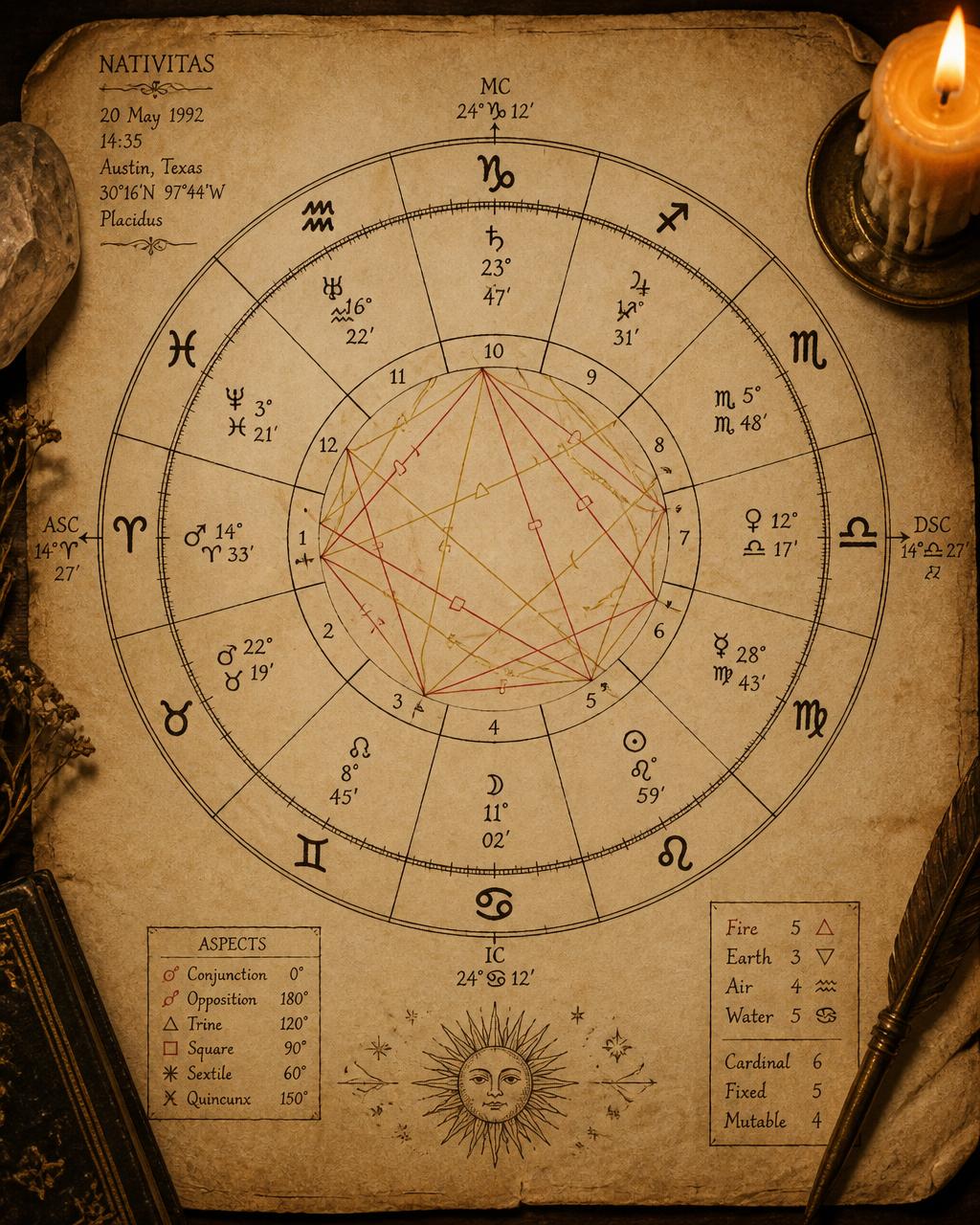
Your natal chart is a photograph of the solar system at your first breath. It never changes. But the planets that posed for it kept orbiting, and astrology's claim about time is simple: when a moving planet returns to a sensitive degree of your fixed chart, the theme of that natal placement gets activated. That contact is a transit.
The mathematics is the same as any chart: positions to the arc-minute, angles measured between the moving sky and the still one. Conjunctions, squares, oppositions, trines. What changes is the question being asked. A natal reading asks who you are. A transit reading asks what time it is in your life, and the two questions are read off the same wheel.
Speed is the key to weight. The Moon crosses your entire chart every month, so its transits are weather: real, but passing. Saturn takes 29 years, Uranus 84, Pluto 248. When one of the slow planets grinds across a natal placement, it does not make a day. It makes a season, sometimes a chapter, and knowing you are in one is frequently the difference between working with it and being worked over by it.